
Why Your Water Heater Is Not Producing Hot Water (And What To Do About It)
If your water heater is not producing hot water, the most likely culprits are a failed heating element, a tripped circuit breaker, a faulty thermostat, or a malfunctioning pilot light. Pinpointing the exact cause takes about 15 minutes of systematic checking, and many fixes cost under $50 in parts.
Most homeowners discover the problem during a morning shower. Cold water comes out and stays cold. That’s the moment to stop guessing and start diagnosing.
Who this is for: This article is written for homeowners and renters in the Los Angeles area who woke up to no hot water and need a clear path from symptom to fix. Not for: HVAC technicians or contractors already familiar with water heater diagnostics. This is practical, not technical theory.
The Most Common Reasons Hot Water Stops
Your water heater is a system, not a single part. One failure point can disable the whole unit. Below are the failures that account for the vast majority of service calls.
Electric water heaters rely on two heating elements, an upper and a lower, each controlled by its own thermostat. When the upper element burns out, you get lukewarm water at best. When the lower element fails, you get a small burst of hot water followed by cold. In practice, the upper element fails more often because it cycles more frequently and handles the initial heating load.
Gas water heaters depend on a functioning pilot light and thermocouple. If the pilot won’t stay lit, the thermocouple is usually worn out. A thermocouple costs $15 to $25 at a hardware store like Home Depot and can be replaced by a careful DIYer. The catch is that some newer sealed-combustion units don’t allow easy thermocouple access, so you may need a technician.
Both types can fail from sediment buildup. In the Los Angeles area, hard water deposits calcium and magnesium at the bottom of the tank over time. A thick layer of sediment insulates the water from the burner or heating element, driving up energy use and eventually causing no-heat situations. The tell: a rumbling or popping sound when the heater runs.
Comparing Electric vs. Gas Water Heater Failure Modes
Before you check anything, confirm whether your unit is electric or gas. The diagnostic path is completely different.
| Failure Point | Electric Water Heater | Gas Water Heater |
|---|---|---|
| Heating element burned out | Very common, upper or lower | Not applicable |
| Pilot light out | Not applicable | Common, especially in drafty utility rooms |
| Thermocouple failure | Not applicable | Common after 5 to 7 years |
| Tripped breaker or GFCI | Common, check panel first | Not applicable |
| Faulty thermostat | Moderately common | Less common |
| Sediment buildup | Common in hard water areas | Common in hard water areas |
| Dip tube failure | Common in units over 8 years | Common in units over 8 years |
The dip tube is a plastic pipe that directs cold incoming water to the bottom of the tank. When it cracks or breaks, cold water mixes directly with hot water at the top. You get tepid water that never gets hot enough. This is the failure most homeowners miss because it leaves no visible clue from the outside.
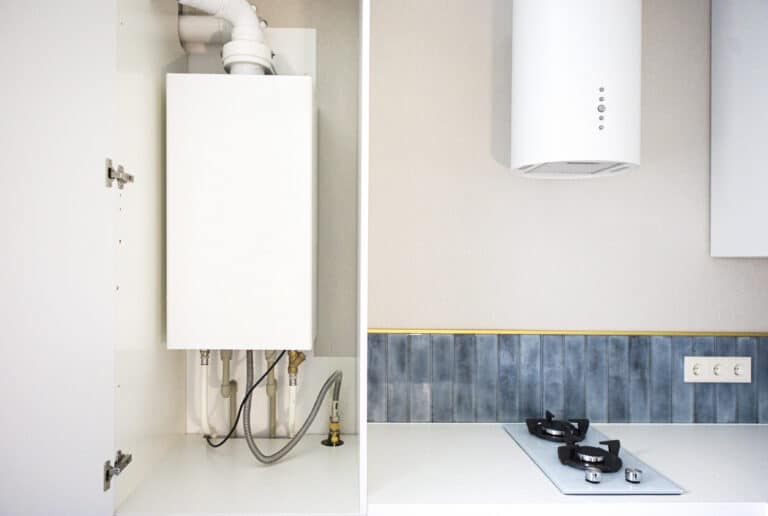
Step-by-Step Diagnostic Checks You Can Do Right Now
Work through these in order. Skipping steps wastes time.
For electric units:
- Check the circuit breaker first. A tripped breaker looks like it’s in the middle position, not fully on or fully off. Reset it firmly.
- If the breaker trips again immediately, you likely have a shorted heating element. Stop and call a plumber.
- Press the red reset button on the high-limit cutoff, usually located behind an access panel midway up the tank. This overheats protector trips when water temperature exceeds 180°F.
- If the reset button won’t hold, your thermostat or element needs replacement.
For gas units:
- Locate the pilot light window (a small glass viewport near the base of the tank) and confirm whether the flame is burning.
- If the pilot is out, follow the manufacturer’s relight instructions printed on the label. Most involve holding the gas knob to “Pilot” for 30 to 60 seconds while pressing an igniter.
- If the pilot relights but goes out again within a minute, the thermocouple is the likely cause.
- Check the gas supply valve on the line leading to the heater. It should be parallel (open) to the pipe, not perpendicular (closed).
What usually trips people up here is assuming the thermostat setting is the problem. Turning the temperature dial up rarely fixes no-heat issues. It can actually mask the underlying failure for a day or two before the problem fully surfaces.
What Sediment Buildup Actually Costs You
Hard water is a real problem in the Los Angeles basin. The Metropolitan Water District of Southern California reports water hardness levels that regularly exceed 200 mg/L in parts of the service area. At that level, sediment accumulates inside a standard 40-gallon tank within two to three years of installation.
| Sediment Severity | Signs | Estimated Energy Cost Increase | Recommended Action |
|---|---|---|---|
| Light (thin film) | Slightly longer heat-up time | 5% to 8% higher | Annual flush |
| Moderate (0.5 to 1 inch layer) | Rumbling sounds, slower recovery | 15% to 20% higher | Professional flush or descale |
| Heavy (over 1 inch) | Inconsistent temps, odors | 30%+ higher | Likely replacement needed |
| Severe (tank floor covered) | No hot water, unit shuts off | Unit may be inefficient beyond repair | Replace tank |
Flushing the tank yourself takes about 20 minutes: connect a garden hose to the drain valve at the base, run it to a floor drain or outside, then open the valve until the water runs clear. Do this once a year. If you’ve never done it and the unit is over five years old, expect murky, rust-colored water initially. That’s normal.
The trade-off with DIY flushing is that older drain valves sometimes won’t reseal properly after being opened for the first time in years. You may create a slow drip that requires a valve replacement. Factor that risk in before you proceed on a unit older than ten years.

Things to Know
- California’s CSLB license lookup tool is free and takes 30 seconds at cslb.ca.gov. Always verify before hiring.
- A permit is legally required in Northridge (unincorporated LA County) for water heater replacements, sewer work, slab leak repairs, and gas line repairs. Unlicensed work without permits can void your homeowner’s insurance.
- Northridge sits within the 1994 earthquake damage zone. If your home was built before 1980, your underground infrastructure has been under seismic stress for over 30 years — camera inspection before any major repair is strongly advised.
- CSUN-area properties often have older plumbing infrastructure under heavier-than-average usage — annual drain maintenance is advisable for multifamily and rental properties in this area.
- Smart plumbing technology including tankless heaters, pressure-balancing valves, and leak sensors is increasingly common in Northridge renovations and can add measurable value to your home.
- Los Angeles’s hard water — delivered from the Colorado River via the Valley distribution system — is one of the hardest municipal water supplies in the country, accelerating mineral buildup inside pipes and water heaters throughout Northridge.

Frequently Asked Questions
Q: How long does it take for a water heater to produce hot water again after being reset?
Most electric water heaters recover fully within 60 to 90 minutes after a successful reset.
A 40-gallon electric unit typically takes about an hour to reheat a full tank from cold. Gas units recover faster, usually within 30 to 45 minutes, because burner output is higher than most electric elements. If you reset the unit and still have no hot water after two hours, the reset did not solve the underlying problem and you need further diagnosis.
Q: Can a water heater stop producing hot water because of a water pressure issue?
Yes, unusually high or low water pressure can interfere with how your water heater performs, particularly on tankless models.
Tankless units require a minimum flow rate to trigger the burner. If a pressure-reducing valve (PRV) in your home is failing and cutting flow too low, the unit simply won’t fire. For tank-style heaters, high pressure can cause the TPR valve to release water repeatedly, which cools the tank faster than it can recover. If your home pressure consistently runs above 80 PSI, a plumber should inspect your PRV.
Q: Is it safe to use a water heater that is making a rumbling or popping noise?
A rumbling noise is not an immediate safety emergency, but it signals heavy sediment buildup that will shorten the unit’s life and raise your energy bills.
The sound comes from water boiling under a thick layer of calcium and magnesium deposits at the tank floor. In hard water areas like Los Angeles, this can develop within three to five years of installation. The unit is still functional in the short term, but flushing it or having a plumber assess it soon prevents more expensive damage later.
Q: My water heater is only 4 years old. Why is it not producing hot water already?
A relatively new unit failing this early usually points to a specific part failure, not general wear, so repair is almost always the right call rather than replacement.
The most common culprits on newer units are a burned-out heating element (electric), a failed thermocouple (gas), a cracked dip tube, or a tripped high-limit switch. Dip tube failures were widespread in units manufactured in the mid-1990s, but off-brand or budget units sold today can still have quality control issues. Check the reset button first, then call a plumber if the problem repeats within 24 hours.
Q: How much does it cost to repair a water heater that has stopped producing hot water in the Los Angeles area?
Repair costs in Los Angeles typically range from $150 to $600 depending on the part and labor involved.
A thermocouple swap runs on the lower end, around $150 to $200 including labor. Replacing both heating elements in an electric unit lands closer to $250 to $400. A dip tube replacement sits in the $200 to $350 range. Full tank replacement, including removal and installation, runs $700 to $1,300 for a standard 40-gallon unit in the LA market. Getting a firm quote before authorizing any work protects you from billing surprises.
The Bottom Line on Your Water Heater Not Producing Hot Water
A cold shower is a clear signal, not a mystery. The causes are finite, the diagnostic steps are sequential, and most repairs are straightforward once you identify the right failure point. Electric units fail at heating elements and thermostats. Gas units fail at pilot assemblies and thermocouples. Both types suffer from sediment in hard water regions like Los Angeles, and both can fail prematurely from a broken dip tube that leaves no external clue.
Start with the free checks: breaker, reset button, pilot light, gas valve. If those clear, move to the components inside the tank. If your unit is over ten years old or the repair estimate approaches half the cost of a new unit, replacement is the more practical path. For Los Angeles homeowners who need a licensed plumber available right now, Expertise Plumbing & Rooter is open 24 hours at (888) 807-7069, located at 8885 Roslyndale Ave, Arleta, CA 91331. Call before the problem gets worse.