
A clogged grease trap or backed-up floor drain can shut down a kitchen, trigger a health code violation, or flood a retail floor during business hours. This guide explains what separates commercial drain work from residential service, what it costs, and how to choose a company that responds fast when a line backs up mid-shift.
This guide explains what actually separates commercial drain work from residential service, what it costs, which method fits which problem, and how to choose a company that won’t leave you waiting when a line backs up mid-shift. It’s written for restaurant owners, property managers, facility managers, and anyone responsible for keeping a commercial building’s plumbing running. If you need someone on-site now, skip to the FAQ or the closing section for how to reach a licensed crew.
Why Commercial Drain Cleaning Is Different From Residential
Commercial drain systems carry far more volume, more grease, and more debris than a home ever will. They’re built with larger-diameter pipe to handle it. A single-family home might run a 2-inch kitchen line; a restaurant kitchen often runs 3- to 4-inch lines feeding a grease interceptor, plus separate floor drains for mop sinks, dish pits, and prep areas. Each of those has its own failure pattern.
Commercial properties also face regulatory exposure that homeowners never deal with. Restaurants must maintain grease interceptors under Los Angeles’s fats, oils, and grease (FOG) rules, and a health inspector who finds a slow drain or grease odor can write it up on the spot. A hotel with a backed-up laundry line loses rooms. A medical office with a clogged floor drain in a sterilization room can face a compliance issue, not just a maintenance one.
Restaurant kitchens build grease faster than any residential line. For commercial properties, jetting the line instead of snaking it is usually the difference between a fix that holds for years and one that fails again in three months.
That combination — bigger pipes, higher volume, code exposure, and real financial consequences for downtime — is why commercial drain cleaning in Los Angeles calls for different equipment, different scheduling, and technicians who understand what’s actually at stake for the business.
Signs Your Business Needs Professional Drain Cleaning Now
Most commercial drain failures give warning signs for days or weeks before they cause a shutdown. The businesses that catch problems early are the ones paying attention to these signals instead of waiting for a full backup:
- Slow-draining floor drains or mop sinks that used to clear in seconds now take minutes
- Recurring clogs in the same fixture — if a drain snake “fixes” it every few weeks, the real blockage is further down the line
- Sewage or grease odors near floor drains, dish pits, or grease trap access points
- Gurgling sounds from drains or toilets when other fixtures are used
- Water backing up into a second fixture when a drain is running (a sink backs up when a toilet flushes, for example)
- Visible grease buildup around trap lids or interceptor covers
- Multiple slow drains at once, which usually points to a main line issue rather than an isolated clog
Any one of these on its own might be minor. Several together, or a pattern that keeps recurring, means the blockage is likely deeper in the system than a store-bought drain product or a quick DIY snake can reach. Waiting until a drain backs up completely — often during service hours — costs far more than addressing it at the first slow-drain warning.
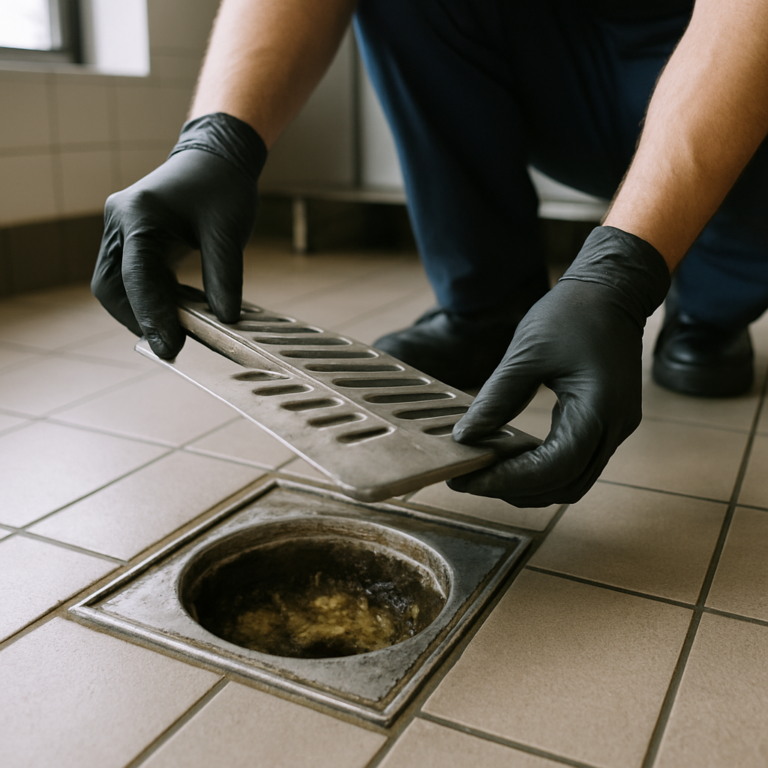
Commercial Drain Cleaning Methods We Use
Not every clog needs the same tool. A qualified commercial drain cleaning service in Los Angeles will match the method to the problem rather than defaulting to the same approach every time.
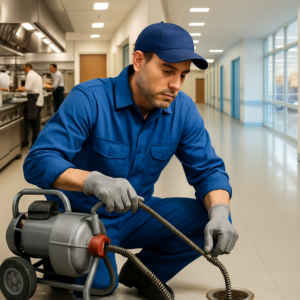
Cabling / snaking. A motorized cable with a cutting head is fed through the line to break up and pull back clogs — hair, debris, small blockages. It’s fast and effective for localized clogs but doesn’t scrub the pipe walls, so grease film and buildup tend to return sooner.
Hydro jetting. High-pressure water is blasted through the line to strip grease, scale, and sludge from the entire interior pipe wall, not just punch a hole through the clog. This is the standard for grease-heavy commercial kitchen lines, main sewer lines, and any pipe with years of buildup. It’s more thorough than cabling and generally lasts longer, though it costs more per visit.
Camera inspection. A waterproof camera is run through the line to show exactly where a blockage, break, root intrusion, or bellied pipe section is located. For commercial properties, this is often used before hydro jetting to confirm the line can handle full pressure, and after service to verify the clog is actually cleared — not just moved.
Enzyme/bacterial treatment. Enzyme-based products break down organic waste and grease on a slower, ongoing basis. These work as a maintenance layer between professional cleanings, not as a fix for an active clog or a grease trap that’s already backing up.
| Method | Best for | Limitations |
|---|---|---|
| Cabling/snaking | Isolated clogs, hair, minor debris | Doesn’t remove grease film; clogs return faster |
| Hydro jetting | Grease trap lines, kitchen drains, main sewer lines | Requires pipe to be in sound condition; higher cost per visit |
| Camera inspection | Diagnosing recurring clogs, pre-jetting checks, root intrusion | Diagnostic only — doesn’t clear the line itself |
| Enzyme treatment | Ongoing maintenance between professional visits | Not effective on active or severe clogs |
For most restaurants and food service operations, the right long-term approach combines periodic hydro jetting with camera verification, backed by enzyme maintenance in between visits. Property managers and offices with lighter drain use may only need cabling and an annual camera check. Full details on how hydro jetting compares to other methods, including realistic cost ranges, are covered on Expertise Plumbing’s drain cleaning service page for Los Angeles.
Drain Cleaning by Industry: Restaurants, Hotels, Medical, Retail & Property Management
Every type of commercial property puts different stress on its drains, and service frequency should reflect that.
Restaurants and food service. The highest-risk category. Grease, food particles, and high water volume from dish pits mean grease traps and kitchen lines need the most frequent attention — often quarterly hydro jetting for busy kitchens, with grease trap pumping on its own separate schedule.
Hotels and hospitality. Laundry lines, guest bathroom lines, and kitchen/banquet drains all run simultaneously at high occupancy. Lint, soap scum, and grease combine in ways that cause slow, gradual buildup rather than sudden clogs — which makes preventive service more valuable than reactive calls.
Medical and dental offices. Sterilization rooms, lab sinks, and specialized fixtures often have stricter cleanliness requirements. Clogs here aren’t just inconvenient — they can interrupt sterile procedures and create compliance concerns with health authorities.
Retail and office buildings. Lower drain volume overall, but floor drains, break room sinks, and restroom lines still need periodic camera checks, especially in older buildings where cast iron or clay sewer lines are more prone to root intrusion or age-related breaks.
Multi-family and property management. Shared sewer lines serving multiple units mean one tenant’s grease dump or wipes-down-the-toilet habit can back up plumbing for an entire building. Property managers benefit most from scheduled maintenance contracts rather than waiting for tenant complaints.
Industrial facilities. Larger-diameter lines, heavier sediment, and sometimes specialized waste (oils, chemicals) that require specific handling and disposal compliance beyond standard drain cleaning.
Things to Know
- Hard water accelerates wear: LA’s water hardness typically ranges from 200-400 mg/L (parts per million), which is considered very hard. Without a pre-filter or softener, expect more frequent descaling service calls.
- Permits protect your investment: Unpermitted water heater installations can void your homeowner’s insurance coverage in the event of a water-related claim.
- Recirculation adds comfort: A recirculation pump paired with your tankless unit delivers hot water to the tap almost instantly instead of making you wait 30-60 seconds, which is a common complaint with basic tankless setups.
- Not all electric panels support whole-home electric units: Older LA homes with 100-amp panels often cannot support a whole-home electric tankless heater without a panel upgrade, adding $1,500-$3,000 to the project.
- Rebates are available now: SoCalGas currently offers rebates for qualifying high-efficiency gas appliances. Ask your contractor to confirm eligibility before purchasing your unit.
- Annual maintenance matters: Flushing and descaling your tankless unit once a year keeps performance consistent and protects the warranty.

Ready to Schedule Your Installation?
Call Expertise Plumbing and Rooter at (888) 807-7069 today and ask for a free on-site assessment. A licensed technician will evaluate your gas line, venting layout, water quality, and household demand, then give you a transparent, itemized quote before any work begins. No surprises, no pressure.
Contact Us!
888-807-7069

Grease Trap & FOG Compliance in Los Angeles
Restaurants and other food service businesses in Los Angeles are required to manage fats, oils, and grease (FOG) under the city’s sewer use and FOG control program, administered by LA Sanitation & Environment. The program exists because grease that goes down drains solidifies in sewer lines, causing blockages and sewage overflows in the public system — not just inside a single building.
In practice, this means food service establishments need a properly sized and maintained grease interceptor or grease trap, regular cleaning and pumping records, and documentation available for inspection. A grease trap that isn’t cleaned on schedule doesn’t just risk a clog. It risks a citation, and repeated violations can affect a business’s standing with health and environmental regulators.
Key insight: Grease trap non-compliance in Los Angeles is rarely caught before a health inspection or a sewer backup — by the time it’s visible, the fine or closure risk has usually already been triggered, so scheduled cleaning is cheaper than reacting after the fact.
A commercial drain cleaning provider familiar with LA’s FOG requirements can help set a cleaning interval that keeps a grease trap under capacity and keeps documentation current, which matters as much for passing inspections as it does for preventing clogs.
Commercial Drain Cleaning Cost in Los Angeles
Commercial drain cleaning pricing depends on drain size, accessibility, the method used, and how severe the blockage is. As a general guide:
- Basic cabling/snaking for a single accessible drain line is typically the least expensive option and suits minor, isolated clogs.
- Hydro jetting costs more per visit because of the equipment and time involved, but it clears grease and buildup more completely and tends to extend the time between service calls — an important factor when weighing cost against downtime.
- Camera inspection is usually priced separately or bundled with jetting service, since it’s diagnostic rather than a fix on its own.
- Grease trap cleaning and main line work cost more than a single fixture drain due to line size, depth, and the volume of material removed.
Access is a major cost driver too — a rooftop drain or a line buried under a parking lot costs more to reach than a drain with a clean-out right at the fixture. For a detailed breakdown of hydro jetting pricing specifically, see Expertise Plumbing’s drain cleaning page, which covers cost factors in more depth. Any reputable commercial drain cleaning company should be willing to give a clear estimate after understanding the drain type and severity, rather than a vague range over the phone.
Why Businesses Across Los Angeles and the San Fernando Valley Choose Expertise Plumbing
Expertise Plumbing & Rooter has served Los Angeles and the San Fernando Valley since 1997, founded by licensed master plumber JC Garcia, who holds CSLB License #1104324 (C-36 Plumbing Contractor) and has spent 29 years working in this trade. The team, including master plumber Carlos Aguilar, is fully licensed, insured, and bonded, and provides same-day service for urgent commercial drain issues throughout the region — including Van Nuys, Sylmar, Encino, Burbank, Glendale, North Hollywood, Woodland Hills, and the greater Los Angeles area.
The business is built around straightforward, upfront pricing with no inflated emergency fees or surprise charges — a philosophy that matters even more for commercial clients managing budgets across multiple properties or locations. Whether it’s a single restaurant grease trap on a recurring schedule or main line service for a multi-family property, the same commitment to clear communication and fair pricing applies. The team is also bilingual in English and Spanish, which matters for businesses whose staff or ownership communicate primarily in Spanish.
For a business dealing with a slow drain, a recurring grease trap issue, or planning a maintenance schedule before problems start, reaching out through the contact page connects directly with a licensed team that understands what’s at stake when a commercial drain fails.
Frequently Asked Questions
How much does commercial drain cleaning cost in Los Angeles?
Cost depends on the drain type, method, and severity of the clog — a simple cabled drain line costs less than hydro jetting a grease-heavy kitchen line or a main sewer line. Access also matters: a drain with an easy clean-out costs less to service than one buried or on a roof. Getting an on-site or phone assessment from a licensed provider is the only way to get an accurate number for a specific property.
How often should a restaurant clean its grease trap?
Frequency depends on kitchen volume, but many high-volume restaurants need grease trap service every one to three months to stay ahead of buildup and remain compliant with Los Angeles’s FOG requirements. A grease trap that’s allowed to fill past capacity risks both a clog and a compliance violation, so it’s better to set a fixed schedule than to wait for visible signs of a problem.
What's the difference between hydro jetting and snaking for commercial drains?
Snaking uses a cable to break through and pull back a specific clog, which is quick but leaves grease film and residue on pipe walls. Hydro jetting uses high-pressure water to scour the entire interior of the pipe, removing buildup more thoroughly and typically extending the time before the next clog forms. Commercial kitchens and grease-heavy lines generally benefit more from hydro jetting; isolated, minor clogs are often fine with cabling.
Can I use store-bought drain cleaner on commercial drains?
Chemical drain cleaners are generally a poor fit for commercial lines. They’re formulated for small residential clogs, can damage certain pipe materials with repeated use, and do nothing for grease trap buildup or main line blockages — the most common commercial issues. For a business, relying on chemical treatments usually just delays a proper fix while the underlying blockage keeps building.
Does my business need a service contract, or can I just call when there's a problem?
It depends on the property, but for restaurants, hotels, and multi-family buildings, a scheduled maintenance contract is almost always cheaper over time than reactive calls, because it avoids emergency fees and the lost revenue from an unexpected shutdown. Lower-volume properties like small offices or retail spaces may reasonably get by with periodic camera checks instead of a full contract.
What happens if my grease trap isn't compliant with LA's regulations?
Non-compliance with Los Angeles’s FOG requirements can result in citations, fines, or in serious cases, sewer connection restrictions, and it often surfaces during a health inspection or after a backup has already occurred. Keeping a grease interceptor properly sized, cleaned on a set schedule, and documented is the most reliable way to avoid enforcement action.
How fast can a commercial drain cleaning company respond to an emergency in LA?
Response times vary by provider, but businesses should look for same-day or 24/7 emergency availability given how quickly a backed-up drain can shut down operations. When comparing providers, ask directly about after-hours response rather than assuming standard business-hours service will be enough for an active backup.
Related Pages
For a deeper look at how drain cleaning methods and pricing work in more detail, see Expertise Plumbing’s dedicated drain cleaning services page, or contact the team directly to schedule a commercial assessment. A clogged drain that’s already affecting business operations shouldn’t wait for a callback — call (888) 807-7069 to reach a licensed, insured team that services commercial properties throughout Los Angeles and the San Fernando Valley.
Resources / References
- LA Sanitation & Environment — Fats, Oils, and Grease (FOG) Control Program information for Los Angeles food service establishments URL: https://www.lacitysan.org/san/faces/home/portal/s-lsh-wq/s-lsh-wq-fog
- California Contractors State License Board — License verification and requirements for plumbing contractors (C-36 classification) URL: https://www.cslb.ca.gov